Science Corner: Mixtures and states of the matter
In this lesson, we will study the matter and the states of matter. In addition, we will discover what mixtures are, which types of mixtures there are and some examples of these we are all very familiar with.

BEFORE class
First, before class, you have to watch a video in which I explain all of these concepts.
Don't forget to write down all your questions and doubts in your notebooks, as I will clarify everything at the beginning of the class.
This is the link to the video:
Here is the link to the ppt:
https://alumnosunir-my.sharepoint.com/:p:/g/personal/rosamaria_bernal701_comunidadunir_net/IQCzgh0PE5K2RLU25LCPMS1iASfFO_rq3BQoU-tdPXNnDTc?rtime=TIPutCJO3kg
IN class
At the beginning of the class, we will address any questions you may have.
Activity 1: Everyone will do this questionnaire with me in class. We will create 5 teams, and each team will have to guess the answers to the following quiz in Quizlet:
https://quizlet.com/es/734614722/matter-states-of-the-matter-and-mixtures-flash-cards/
Activity 2: In groups of 5 students, complete the following chart and the drawings:
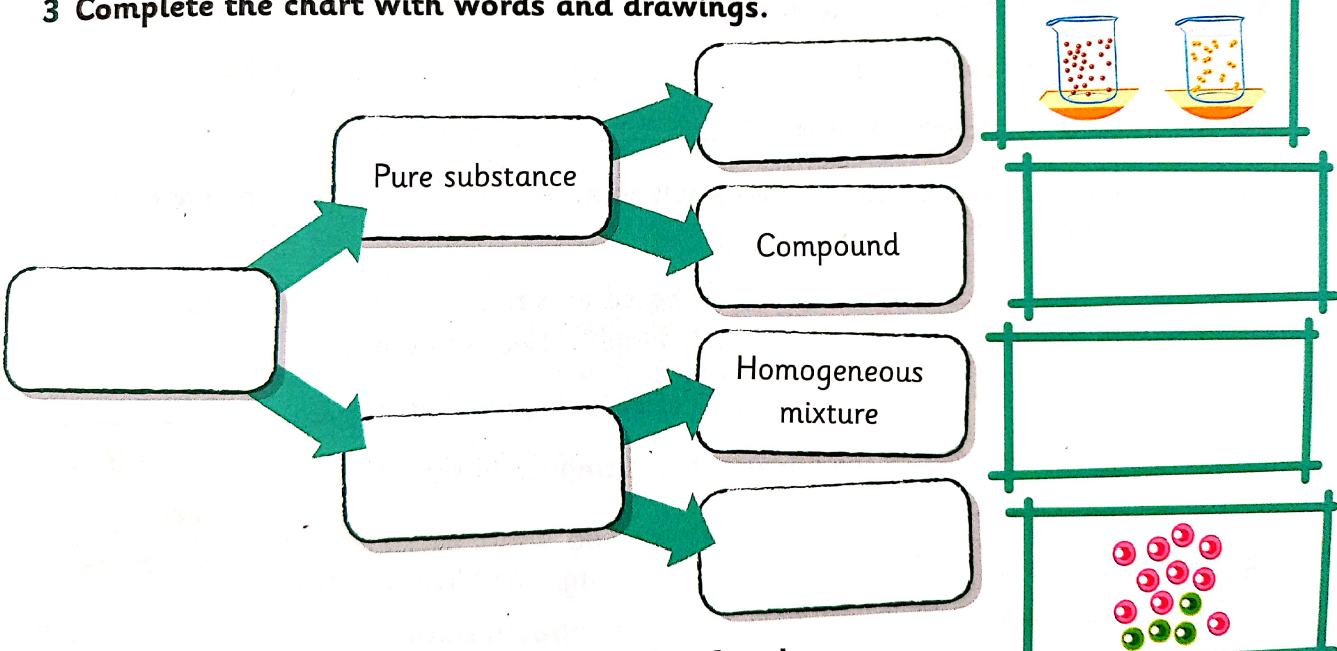
Activity 3: In your notebook, write definitions and give an example of each:
3A)Heterogenous mixture: ______________________________________
Examples:_____________________________________________________
3B) Homogenous mixture: _______________________________________
Examples: _____________________________________________________
3C) The 3 states of the matter are __________________________
depending on how much ENERGY it has.
Activity 4: Experiment time!
Which solids dissolve in water?
Materials:
Water (hot and cold)
clear plastic cups
a teaspoon
substances: SUGAR, SAND, SALT, COFFEE
Method
step 1: take a glass of hot water and a glass of cold water. Then add a teaspoon of whichever solid you are testing, stir and observe the difference.
step 2: test and see if the solid dissolves in hot water and cold water and if it dissolves better in one or the other.
step 3: repeat this process with the four substances.
step 4: repeat this process with the four substances.

Bibliographic references
Cambridge Natural Science Level 6 Pupil’s Book; Natural Science Primary. (2019, 28 febrero). Cambridge University Press. (44-48).
Cambridge Natural Science Level 6 Activity Book; Natural Science Primary. (2019, 28 febrero). Cambridge University Press. (20-21).
dissolving experiment. (s. f.). twinkl.com.
Images from Freepik. (s. f.). https://www.freepik.es/.


Comments
Post a Comment